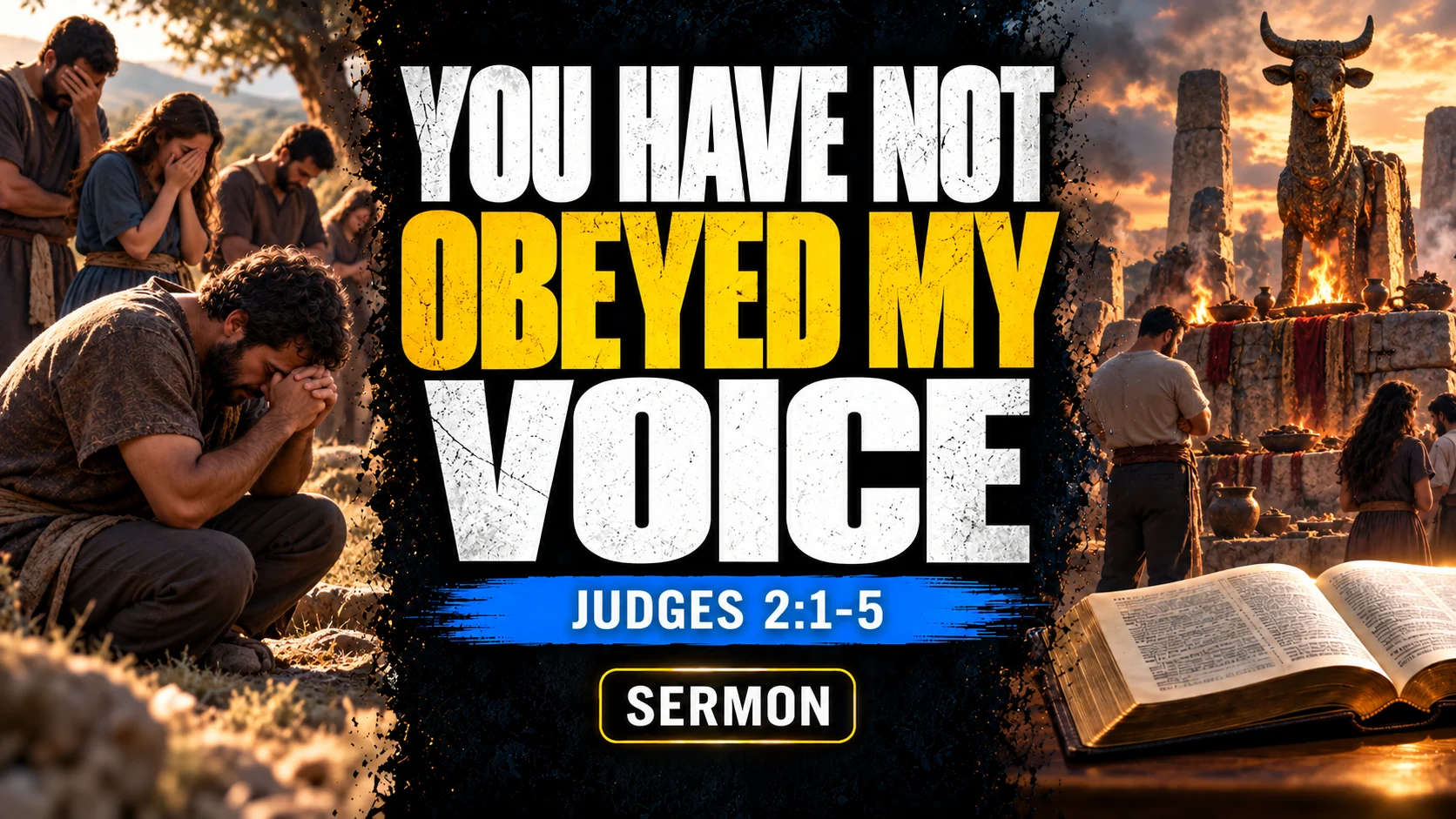
Read the sermon.
Follow the message from the opening text through the conclusion.
God had faithfully kept His word to Israel, but Israel had not obeyed His voice, and their compromise brought painful consequences that moved the people to weep before the LORD.
TEXT
1And an angel of the LORD came up from Gilgal to Bochim, and said, I made you to go up out of Egypt, and have brought you unto the land which I sware unto your fathers; and I said, I will never break my covenant with you.
2And ye shall make no league with the inhabitants of this land; ye shall throw down their altars: but ye have not obeyed my voice: why have ye done this?
3Wherefore I also said, I will not drive them out from before you; but they shall be as thorns in your sides, and their gods shall be a snare unto you.
4And it came to pass, when the angel of the LORD spake these words unto all the children of Israel, that the people lifted up their voice, and wept.
5And they called the name of that place Bochim: and they sacrificed there unto the LORD.
Confirm the Bible Reading, then answer the three Bible facts below.
INTRODUCTION
Judges 2:1-5 records the LORD’s rebuke after the incomplete conquest described in Judges 1. Israel had entered the land God promised, yet tribe after tribe allowed Canaanites to remain, and in some places Israel became strong enough to put them under tribute instead of driving them out.
Judges is Book 7 of 66, and Judges 2 is chapter 2 of 21 in Judges and chapter 213 of 1,189 in the Bible. These opening verses close the account of Israel’s incomplete conquest. Later in this chapter, the book explains the repeated cycle of idolatry, oppression, crying unto the LORD, and deliverance through judges.
Judges 1 tells us what Israel did. Judges 2:1-5 gives God’s judgment on it. Before the LORD says, “ye have not obeyed my voice,” He first establishes His own faithfulness. The rebuke begins with the LORD saying, “I will never break my covenant with you.”
Which statement best summarizes the sermon introduction?
I. I WILL NEVER BREAK MY COVENANT WITH YOU — VERSES 1-2
And an angel of the LORD came up from Gilgal to Bochim, and said, I made you to go up out of Egypt, and have brought you unto the land which I sware unto your fathers; and I said, I will never break my covenant with you.
The angel of the LORD speaks in God’s own first person: “I made you to go up,” “I have brought you,” and “I will never break my covenant.” Many Christians understand appearances like this as the preincarnate Christ. Judges 2:1 does not identify Him as the Son, so that remains an interpretation. The verse plainly presents this messenger speaking with the LORD’s authority and words.
Look at what God puts before the accusation. “I made you to go up out of Egypt.” He had delivered them. “I have brought you unto the land.” He had fulfilled His promise. “Which I sware unto your fathers.” Their possession of Canaan rested on a promise God had made long before this generation entered the land.
Then He says, “I will never break my covenant with you.” God’s faithfulness stands established before Israel’s failure is named. He brought them out, brought them in, and kept the word He had sworn.
And ye shall make no league with the inhabitants of this land; ye shall throw down their altars: but ye have not obeyed my voice: why have ye done this?
God names two commands: make no league with the inhabitants, and throw down their altars. The word translated “covenant” in verse 1 and “league” in verse 2 is the same Hebrew word. The contrast is sharp. God says He will keep His covenant, while Israel had entered the kind of accommodation He had forbidden.
The altars show the spiritual danger. The people Israel left in the land brought false worship with them. God had warned Israel about that before they ever settled there.
Take heed to thyself, lest thou make a covenant with the inhabitants of the land whither thou goest, lest it be for a snare in the midst of thee: But ye shall destroy their altars, break their images, and cut down their groves:
The command was clear. Judges 1 records tribe after tribe failing to drive the inhabitants out. It even records Israel becoming strong enough to put some Canaanites under tribute rather than utterly driving them out. Judges 2 gives God’s verdict on that history: “ye have not obeyed my voice.”
God asks, “why have ye done this?” The verse records no answer. Fear, convenience, profit, or weariness may have played a part, but Scripture does not name the controlling motive. God gives us the issue: He had spoken, and they had not obeyed.
That is a searching standard for us. Partial obedience becomes disobedience when we knowingly stop short of what God said. We do not get to rename compromise because it became useful, profitable, or easier to live with. When Scripture is clear, the right response is to obey God’s voice.
Which statement best matches what is taught in I. I WILL NEVER BREAK MY COVENANT WITH YOU — VERSES 1-2?
II. I WILL NOT DRIVE THEM OUT FROM BEFORE YOU — VERSE 3
Wherefore I also said, I will not drive them out from before you; but they shall be as thorns in your sides, and their gods shall be a snare unto you.
“Wherefore” ties this consequence directly to verse 2. Israel had refused God’s command concerning the inhabitants, and those inhabitants would now remain as continuing trouble. The words “I also said” fit the warnings God had already given before Israel’s failure.
But if ye will not drive out the inhabitants of the land from before you; then it shall come to pass, that those which ye let remain of them shall be pricks in your eyes, and thorns in your sides, and shall vex you in the land wherein ye dwell.
God had warned them before the consequence came. The people they allowed to remain would become “thorns in your sides.” A thorn keeps hurting. The very people Israel left in place contrary to God’s command would become an ongoing source of trouble.
Then God says, “their gods shall be a snare unto you.” A snare is a trap. Their religion would pull Israel toward idolatry. The inhabitants became thorns, and their gods became a snare. Judges shows both problems: enemies oppress Israel, and Israel turns after false gods.
Psalm 106 later gives an inspired summary of this same failure.
They did not destroy the nations, concerning whom the LORD commanded them: But were mingled among the heathen, and learned their works. And they served their idols: which were a snare unto them.
The warning of Judges 2:3 became Israel’s history. They left the nations. They mingled among them. They learned their works. Then they served their idols. The snare caught them exactly where God had warned them.
Verse 3 also keeps us from misunderstanding verse 1. God remained faithful when He announced consequences. His covenant faithfulness never gave Israel permission to presume on continued blessing while they disobeyed Him.
Israel’s conquest command belonged to Israel in Canaan, but the passage still gives us a practical lesson. God’s warnings deserve to be believed before experience proves them painful. We should never wait for the thorn or the snare to convince us that God knew what He was talking about. When His Word warns us about sin, compromise, or false worship, wisdom obeys before the damage grows.
Which statement best matches what is taught in II. I WILL NOT DRIVE THEM OUT FROM BEFORE YOU — VERSE 3?
III. THE PEOPLE LIFTED UP THEIR VOICE, AND WEPT — VERSES 4-5
And it came to pass, when the angel of the LORD spake these words unto all the children of Israel, that the people lifted up their voice, and wept.
The rebuke was addressed to “all the children of Israel,” and their response was public. The people lifted up their voice and wept.
There is a connection in the wording. Verse 2 says, “ye have not obeyed my voice.” Verse 4 says, “the people lifted up their voice, and wept.” The same Hebrew word for “voice” appears in both places. They had refused the LORD’s voice, and now they raised their own voice in sorrow after hearing His judgment.
Their sorrow was real enough to produce weeping. Scripture does not tell us what was in every heart. They may have grieved over their disobedience, over the announced consequences, or over both. The text gives us what we can say with confidence: they heard the rebuke, they lifted up their voice, and they wept.
And they called the name of that place Bochim: and they sacrificed there unto the LORD.
Bochim is connected with weeping and is commonly understood as “weepers.” Their sorrow marked the place itself. They also sacrificed there unto the LORD, so their response included worship as well as tears.
Their tears did not erase the consequences God had announced. The thorns and snares remain in the story, and the chapters that follow show Israel falling into the very idolatry God warned about. Their sorrow was serious, but the larger national pattern of disobedience continued.
That presses the application beyond emotion. God’s Word should move us, but correction should lead into obedience. Tears can be sincere. Worship can be sincere. The fitting response when God exposes disobedience is to hear His voice and obey what He said.
Which statement best matches what is taught in III. THE PEOPLE LIFTED UP THEIR VOICE, AND WEPT — VERSES 4-5?
CONCLUSION
God had given Israel every reason to trust His voice. He brought them out of Egypt, brought them into the land, kept the covenant He had made, and warned them plainly about the danger of the people and the gods they were allowing to remain.
Then came the thorn. Then came the snare. Then came the weeping.
God’s Word is meant to govern us before consequences arrive. When He speaks clearly, wisdom receives His command as right and obeys it. Compromise may look easier for a while, but Israel learned that God’s warnings were mercy spoken ahead of pain.
And when His Word exposes disobedience, sorrow should move us toward obedience. Tears cannot go backward and erase every consequence already set in motion, but we can still hear the voice of God today and respond rightly.
Israel heard the question, “why have ye done this?” Better to obey God’s voice now than to lift up our voice later over what He already warned us about.
Which statement best summarizes the conclusion of this sermon?
She Happened Upon the Right Field
Continue with the next sermon in the archive.