Read the sermon.
Follow the message from the opening text through the conclusion.
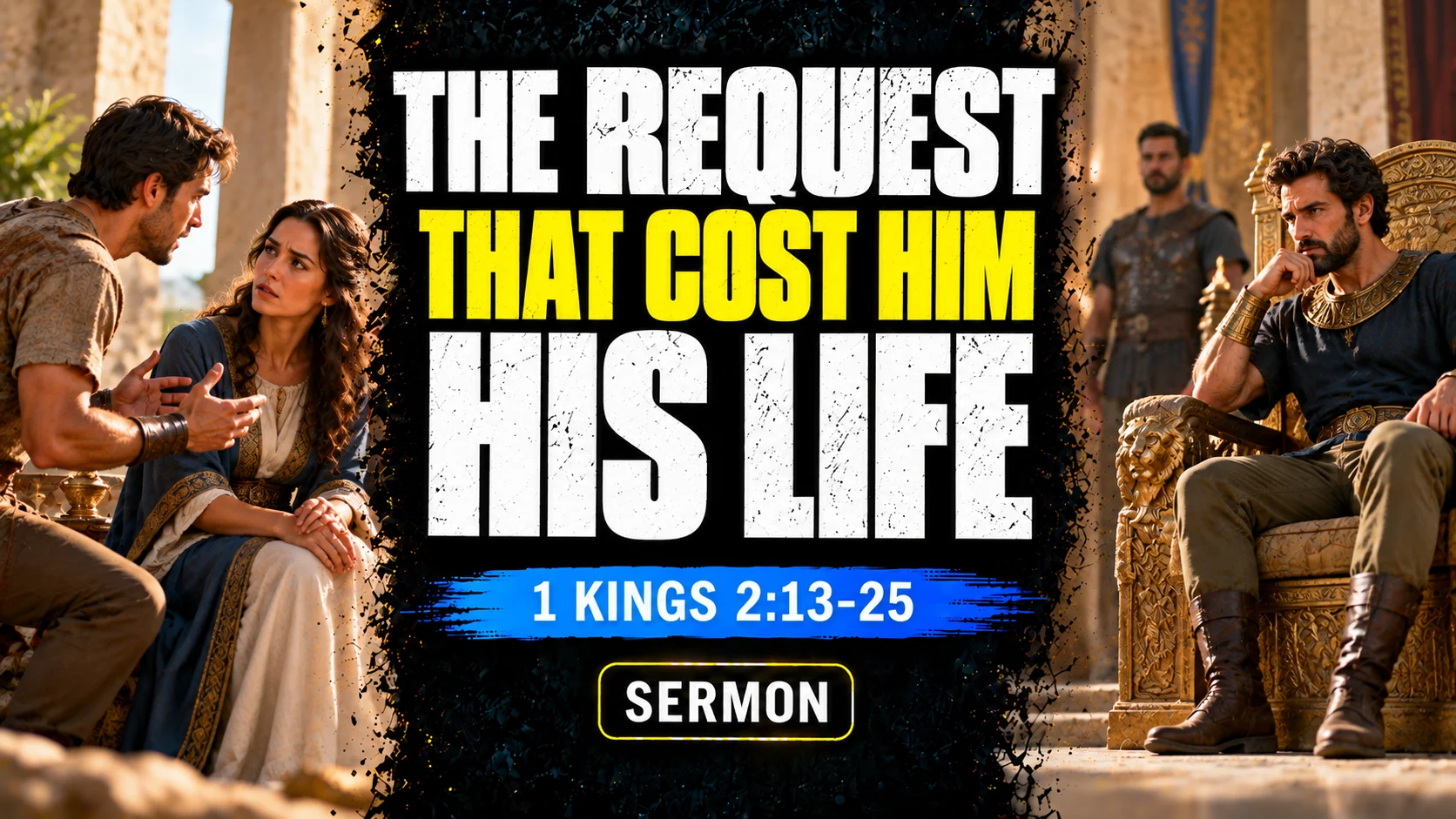
Adonijah’s request for Abishag exposed that his ambition for the kingdom was not dead, and the request that appeared small became the final act that cost him his life.
TEXT
13And Adonijah the son of Haggith came to Bathsheba the mother of Solomon. And she said, Comest thou peaceably? And he said, Peaceably.
14He said moreover, I have somewhat to say unto thee. And she said, Say on.
15And he said, Thou knowest that the kingdom was mine, and that all Israel set their faces on me, that I should reign: howbeit the kingdom is turned about, and is become my brother’s: for it was his from the LORD.
16And now I ask one petition of thee, deny me not. And she said unto him, Say on.
17And he said, Speak, I pray thee, unto Solomon the king, (for he will not say thee nay,) that he give me Abishag the Shunammite to wife.
18And Bathsheba said, Well; I will speak for thee unto the king.
19Bathsheba therefore went unto king Solomon, to speak unto him for Adonijah. And the king rose up to meet her, and bowed himself unto her, and sat down on his throne, and caused a seat to be set for the king’s mother; and she sat on his right hand.
20Then she said, I desire one small petition of thee; I pray thee, say me not nay. And the king said unto her, Ask on, my mother: for I will not say thee nay.
21And she said, Let Abishag the Shunammite be given to Adonijah thy brother to wife.
22And king Solomon answered and said unto his mother, And why dost thou ask Abishag the Shunammite for Adonijah? ask for him the kingdom also; for he is mine elder brother; even for him, and for Abiathar the priest, and for Joab the son of Zeruiah.
23Then king Solomon sware by the LORD, saying, God do so to me, and more also, if Adonijah have not spoken this word against his own life.
24Now therefore, as the LORD liveth, which hath established me, and set me on the throne of David my father, and who hath made me an house, as he promised, Adonijah shall be put to death this day.
25And king Solomon sent by the hand of Benaiah the son of Jehoiada; and he fell upon him that he died.
Confirm the Bible Reading, then answer the three Bible facts below.
INTRODUCTION
First Kings 2 records the final settling of Solomon’s throne after David’s death. In this passage Adonijah comes to Bathsheba, asks her to carry a request to Solomon, and the request that sounds small ends with Adonijah’s death.
First Kings is Book 11 of 66, and 1 Kings 2 is chapter 2 of 22 in this book and chapter 293 of 1,189 in the Bible. David has died, Solomon is sitting on his father’s throne, and the kingdom is being established in his hand. But chapter 1 left one serious matter unfinished. Adonijah had exalted himself and tried to become king. When Solomon was publicly established, Adonijah feared for his life, caught hold of the horns of the altar, and received mercy on the condition that he show himself a worthy man.
So Adonijah enters this passage as a man whose life has already been spared once. When he comes to Bathsheba claiming that he comes peaceably, the old struggle over the kingdom is about to surface again.
Which statement best summarizes the sermon introduction?
I. I ASK ONE PETITION OF THEE — VERSES 13-18
And Adonijah the son of Haggith came to Bathsheba the mother of Solomon. And she said, Comest thou peaceably? And he said, Peaceably.
He said moreover, I have somewhat to say unto thee. And she said, Say on.
Bathsheba’s first question fits their history. Adonijah had recently tried to take the kingdom, and she begins by asking whether he comes peaceably.
Verse 14 calls his business somewhat. As the conversation moves forward, it becomes one petition, then one small petition, and finally Solomon says the request reaches to the kingdom also.
And he said, Thou knowest that the kingdom was mine, and that all Israel set their faces on me, that I should reign: howbeit the kingdom is turned about, and is become my brother’s: for it was his from the LORD.
Before Adonijah mentions Abishag, he talks about the throne. His claim that the kingdom had been his is Adonijah’s description. Chapter 1:5 describes him as exalting himself and declaring that he would be king. He had real support, but chapter 1 also names men who refused to follow him. All Israel is Adonijah’s own broad account of the former struggle.
Then he admits that Solomon had received the kingdom from the LORD. Adonijah knows that Solomon’s kingdom came from God. A person can recognize what God has done and still struggle to leave alone what God gave to somebody else. Submission means living according to the truth we say we believe.
And now I ask one petition of thee, deny me not. And she said unto him, Say on.
And he said, Speak, I pray thee, unto Solomon the king, (for he will not say thee nay,) that he give me Abishag the Shunammite to wife.
And Bathsheba said, Well; I will speak for thee unto the king.
Adonijah asks Bathsheba not to deny him before he names the petition, then says Solomon will not deny her. He chose an intermediary with special access to the king.
Abishag had personally ministered to David during his final weakness. First Kings 1:4 records that David never knew her sexually, so her exact status must be handled carefully. Yet she was closely associated with David’s royal household. Bathsheba agrees to carry the request. The text leaves her understanding of its political meaning unstated.
Which statement best matches what is taught in I. I ASK ONE PETITION OF THEE — VERSES 13-18?
II. ASK FOR HIM THE KINGDOM ALSO — VERSES 19-22
Bathsheba therefore went unto king Solomon, to speak unto him for Adonijah. And the king rose up to meet her, and bowed himself unto her, and sat down on his throne, and caused a seat to be set for the king’s mother; and she sat on his right hand.
Then she said, I desire one small petition of thee; I pray thee, say me not nay. And the king said unto her, Ask on, my mother: for I will not say thee nay.
Solomon honors his mother by rising, bowing, and giving her a seat at his right hand. Yet Solomon sits on the throne. Bathsheba has access; Solomon must judge the request.
Bathsheba calls the request small. Calling something small does not settle what it means. Its history and consequences still have to be judged.
And she said, Let Abishag the Shunammite be given to Adonijah thy brother to wife.
And king Solomon answered and said unto his mother, And why dost thou ask Abishag the Shunammite for Adonijah? ask for him the kingdom also; for he is mine elder brother; even for him, and for Abiathar the priest, and for Joab the son of Zeruiah.
Solomon supplies the controlling interpretation by saying that asking for Abishag is like asking for the kingdom also. Adonijah is his elder brother, the man who had already claimed the throne. Abiathar and Joab are the same two major men who had supported Adonijah in chapter 1. Solomon hears the request in that history.
The Bible also shows why a woman connected with a king could carry political meaning.
And Ahithophel said unto Absalom, Go in unto thy father’s concubines, which he hath left to keep the house; and all Israel shall hear that thou art abhorred of thy father: then shall the hands of all that are with thee be strong.
Abishag’s situation was different because David had not known her sexually, but Absalom’s rebellion shows the political meaning that could attach to women from a king’s household.
The narrator never opens Adonijah’s mind and tells us every motive. Solomon’s judgment is clear enough: he connected Abishag, Adonijah’s seniority, the former faction, and the kingdom. Discernment should use known facts without inventing facts the Bible never gives.
Which statement best matches what is taught in II. ASK FOR HIM THE KINGDOM ALSO — VERSES 19-22?
III. SPOKEN THIS WORD AGAINST HIS OWN LIFE — VERSES 23-25
Then king Solomon sware by the LORD, saying, God do so to me, and more also, if Adonijah have not spoken this word against his own life.
The request presented as small is now judged to have been spoken against Adonijah’s own life. Solomon makes a solemn oath and judges that Adonijah has crossed the line established when his life was spared after the first rebellion.
And Solomon said, If he will shew himself a worthy man, there shall not an hair of him fall to the earth: but if wickedness shall be found in him, he shall die.
Adonijah had already stood under judgment and received mercy. Solomon sent him home alive. That mercy gave him a chance to live peaceably under the king; it was never permission to move back toward the throne that had brought him under judgment.
Now therefore, as the LORD liveth, which hath established me, and set me on the throne of David my father, and who hath made me an house, as he promised, Adonijah shall be put to death this day.
Solomon grounds his throne in the LORD’s action. The LORD established him, set him on David’s throne, and made him a house according to His promise. That answers Adonijah’s own words in verse 15. Adonijah had admitted that Solomon had received the kingdom from the LORD. His request reaches toward something he had already acknowledged God had settled.
And king Solomon sent by the hand of Benaiah the son of Jehoiada; and he fell upon him that he died.
The ending is brief. Adonijah came claiming peace. He spoke of one petition. Bathsheba called it small. Solomon heard a threat to the kingdom, and the mercy of chapter 1 came to an end.
Mercy should move us away from the rebellion that brought us into trouble, never give us an excuse to move back toward it.
Which statement best matches what is taught in III. SPOKEN THIS WORD AGAINST HIS OWN LIFE — VERSES 23-25?
CONCLUSION
Adonijah’s last request carried the weight of everything that came before it. He had already reached for the kingdom, already been defeated, already received mercy, and already admitted that Solomon’s throne was from the LORD. Yet the request he sent through Bathsheba reached back into that same struggle.
That is why we must judge more than the label somebody puts on an action. Calling something small does not erase its history. Peaceful words do not erase where a course of action leads. And acknowledging what God has done with our mouth should lead us to order our conduct by that truth.
When God has settled something, stop reaching for what He did not give you. When mercy has spared you, use that mercy to walk away from the rebellion, not back toward it.
Adonijah called it one petition. Solomon saw the kingdom behind it. The request that looked small became the request that cost him his life.
Which statement best summarizes the conclusion of this sermon?
When Moab Rebelled
Continue with the next sermon in the archive.