Read the sermon.
Follow the message from the opening text through the conclusion.
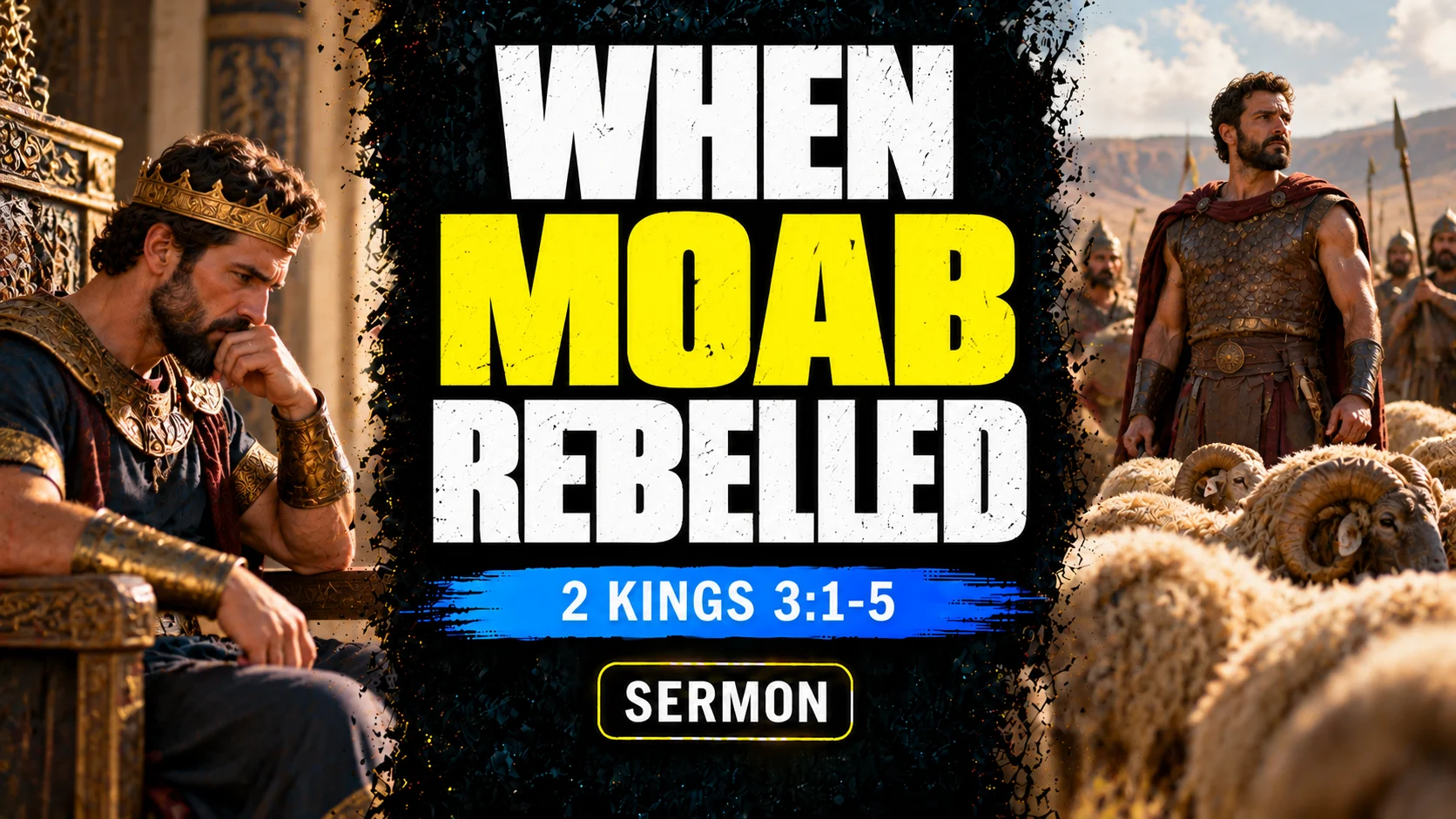
Jehoram rejected part of his father’s idolatry but still held to the sins of Jeroboam, and when Ahab died, Moab seized the moment to rebel against Israel.
TEXT
1Now Jehoram the son of Ahab began to reign over Israel in Samaria the eighteenth year of Jehoshaphat king of Judah, and reigned twelve years.
2And he wrought evil in the sight of the LORD; but not like his father, and like his mother: for he put away the image of Baal that his father had made.
3Nevertheless he cleaved unto the sins of Jeroboam the son of Nebat, which made Israel to sin; he departed not therefrom.
4And Mesha king of Moab was a sheepmaster, and rendered unto the king of Israel an hundred thousand lambs, and an hundred thousand rams, with the wool.
5But it came to pass, when Ahab was dead, that the king of Moab rebelled against the king of Israel.
Confirm the Bible Reading, then answer the three Bible facts below.
INTRODUCTION
Second Kings opens during a major change in Israel. Ahab is dead. His son Ahaziah has also died without a son. Elijah has been taken up, Elisha has begun his public ministry, and another son of Ahab now sits on Israel’s throne. Moab has already broken away from Israel, so Jehoram begins his reign with a serious problem waiting for him.
2 Kings is Book 12 of 66, and 2 Kings 3 is chapter 316 of 1,189 in the Bible. It is chapter 3 of 25 in 2 Kings. Before this chapter tells us what Jehoram will do about Moab, it tells us who Jehoram is and how the LORD views his reign.
These five verses move from Jehoram taking the throne, to God’s judgment of his conduct, to the tribute Israel was losing when Moab rebelled. Jehoram the son of Ahab begins to reign.
Which statement best summarizes the sermon introduction?
I. JEHORAM THE SON OF AHAB BEGAN TO REIGN — VERSE 1
Now Jehoram the son of Ahab began to reign over Israel in Samaria the eighteenth year of Jehoshaphat king of Judah, and reigned twelve years.
Jehoram is introduced as “the son of Ahab.” That connects him immediately with the house that has ruled Israel through Ahab and then Ahaziah. Ahab is gone, Ahaziah is gone, and now another son of Ahab sits on the throne.
Jehoram reigns over Israel from Samaria while Jehoshaphat rules Judah. He will reign twelve years. Verse 1 gives the facts of his reign. Verse 2 gives God’s judgment of it. A throne and twelve years in power could never tell us whether Jehoram was right with God.
Which statement best matches what is taught in I. JEHORAM THE SON OF AHAB BEGAN TO REIGN — VERSE 1?
II. HE WROUGHT EVIL; NEVERTHELESS HE CLEAVED UNTO THE SINS OF JEROBOAM — VERSES 2-3
And he wrought evil in the sight of the LORD; but not like his father, and like his mother: for he put away the image of Baal that his father had made.
God’s judgment comes first: “he wrought evil in the sight of the LORD.” The standard is the LORD’s judgment. Jehoram may be compared with his parents in the rest of the verse, but that comparison never changes the first statement. God says he did evil.
Jehoram was different from Ahab and Jezebel in one real way. Ahab had served Baal, built an altar and house for Baal in Samaria, and promoted that worship in Israel. Jehoram “put away the image of Baal that his father had made.” Scripture gives him credit for that change.
The verse says “put away.” Jehoram removed the image his father had made. Scripture gives no motive and does not say that he removed every trace of Baal worship from Israel. He changed something that was wrong, and God still said he did evil.
That keeps us from grading ourselves by somebody worse. A man can say, “I am not as bad as him.” He may be right about the comparison and still be wrong before God. Jehoram was not like Ahab and Jezebel in this matter. God still measured Jehoram “in the sight of the LORD.”
Nevertheless he cleaved unto the sins of Jeroboam the son of Nebat, which made Israel to sin; he departed not therefrom.
“Nevertheless” tells us why verse 2 was not the whole story. Jehoram put away one evil, yet he held onto another. He “cleaved unto” the sins of Jeroboam, and “he departed not therefrom.” He remained attached to a sinful course that had been established generations earlier.
Jeroboam had built an alternative system of worship for the northern kingdom.
Whereupon the king took counsel, and made two calves of gold, and said unto them, It is too much for you to go up to Jerusalem: behold thy gods, O Israel, which brought thee up out of the land of Egypt. And he set the one in Bethel, and the other put he in Dan. And this thing became a sin: for the people went to worship before the one, even unto Dan.
Jeroboam also established high places, appointed priests who were not the sons of Levi, and created a feast according to what he had devised in his own heart in 1 Kings 12:31-33. By Jehoram’s day, that system had been in Israel for generations. Age did not make it right. Tradition did not make it right. Jehoram did not invent those sins, but he chose to keep walking in them.
The word “cleaved” shows what he held onto. Joshua had told Israel:
But cleave unto the LORD your God, as ye have done unto this day.
Jehoram should have cleaved to the LORD. Instead, he cleaved to the sins of Jeroboam. He knew how to put away the image of Baal, but there were sins from which “he departed not.”
That reaches us plainly. Correcting one wrong thing does not give us permission to keep another wrong thing. A man may stop one sinful habit while protecting another. A family may correct one practice while keeping another because it has always been done that way. A church may reject one false teaching while holding onto another tradition that does not agree with Scripture.
Verse 3 also says Jeroboam “made Israel to sin.” Jeroboam had been dead for generations, yet his choices were still affecting the nation. Leaders teach by what they permit, establish, and repeat. Fathers, mothers, pastors, teachers, and other leaders should care about what they make normal for the people who follow them.
Which statement best matches what is taught in II. HE WROUGHT EVIL; NEVERTHELESS HE CLEAVED UNTO THE SINS OF JEROBOAM — VERSES 2-3?
III. THE KING OF MOAB REBELLED AGAINST THE KING OF ISRAEL — VERSES 4-5
And Mesha king of Moab was a sheepmaster, and rendered unto the king of Israel an hundred thousand lambs, and an hundred thousand rams, with the wool.
Now the passage turns to Moab. Mesha is called a “sheepmaster,” and the tribute matches that description. He rendered to Israel one hundred thousand lambs and one hundred thousand rams, with the wool.
The verse does not tell us the exact payment schedule, so we do not need to guess at it. It tells us enough to understand the size of the relationship. Moab had been under Israel’s authority, and Israel was receiving an enormous amount of livestock wealth from Moab.
Israel could receive great tribute while its king was doing evil in the sight of the LORD. Money, growth, and power do not prove that God approves of what we are doing. Success cannot reverse what God has already said about right and wrong.
But it came to pass, when Ahab was dead, that the king of Moab rebelled against the king of Israel.
Verse 4 says Mesha “rendered.” Verse 5 says he “rebelled.” The tribute and submission described in verse 4 gave way to open rebellion in verse 5.
The timing is tied to Ahab’s death. The book had already told us this in its opening verse.
Then Moab rebelled against Israel after the death of Ahab.
Moab’s rebellion therefore began after Ahab died. It was already an unresolved problem when Jehoram came to the throne. Chapter 3 repeats that fact because verse 6 will show Jehoram gathering Israel to respond.
Jehoram inherited this problem. He did not start the rebellion recorded here. We also face problems that began before they reached us, and we are still responsible for how we respond once they are ours to face.
Jehoram was doing evil, and Jehoram also faced a political crisis. The passage places those facts next to each other, but it never says his sin caused Moab’s rebellion. It tells us what kind of king Jehoram was as he prepared to face that rebellion.
Which statement best matches what is taught in III. THE KING OF MOAB REBELLED AGAINST THE KING OF ISRAEL — VERSES 4-5?
CONCLUSION
Before Jehoram ever marches against Moab, God has already told us how to see the king. Jehoram removed the image of Baal, yet he still cleaved to the sins of Jeroboam. One right change did not make the rest of his conduct right.
We should let God’s Word examine us the same way. Do not ask only whether you are better than somebody else. Do not point to one change you made while protecting something else that Scripture says is wrong. Be willing to leave what is wrong, even when it is old, familiar, or accepted by the people around you.
Israel had power, tribute, and wealth, and then Moab rebelled. Those outward things could change quickly. God’s judgment of right and wrong did not change.
When Moab rebelled, the greatest question was not how much Jehoram had lost. God had already shown us the deeper problem: Jehoram had put something away, but he still would not depart from what was wrong.
Which statement best summarizes the conclusion of this sermon?
Continue in the sermon library.
Browse preaching by passage, tag, series, and date.